
Muck Rack rolls out new AI features; Onclusive sews its acquisitions together; plus PR tech briefs and new vendor survey data
April of this year will mark the seventh consecutive year I’ve provided steady summaries stemming from the world of PR software makers. When I started, I was providing updates on a dizzying array of announcements.
Many of them were around mergers and acquisitions (M&A). Too many in my book for any one company to effectively integrate them. I know that because over my career I’ve been involved, from a communications standpoint, in more than a dozen transactions.
Sometimes I was part of the acquiring company. Other times, I was part of a company being acquired. I even had a chance to do a divestiture while in-house, and then pick that divested company up as a customer years later on the consulting side. It’s given me a vantage point of what happens before, during and after these transactions.
I’ve concluded that M&A is easy to plan for and hard to execute. Executives put too much credence into their assumptions and not enough in the variables. Many fall in love with a deal, which blinds them to the risks that require mitigation, and sends a personalized invitation to join the sunk cost fallacy.
The variables are many. Employees want a purpose. Customers are fickle. Markets are unforgiving. When you start to add a second or third M&A on top of one that’s barely been swallowed, it quickly becomes a project that’s unwieldy to manage.
The pace of M&A has certainly slowed, even as I’ve pared back these missives from monthly to quarterly. The playing field I started covering in 2019 looks very different today – yet there’s still room left for one more deal, albeit one that makes sense – even as some of the old ones are still getting straightened out.
1. Signal AI acquires Memo for readership data
Media monitoring provider Signal AI announced it acquired Memo. Memo is a communications measurement platform that centers on providing readership data for placements. Instead of guessing how many people may have read an article, Memo provides data.
“Memo’s data is sourced directly from publishers via a network of data partners with direct integrations,” said Signal AI CEO David Benigson in an email exchange. “It’s not modelled or inferred, it’s based on actual readership data from the publisher side.”
Planned product integration
“This acquisition will integrate real readership metrics into Signal AI’s reputation and risk intelligence platform and services, giving Chief Communications Officers (CCOs) and reputation management teams a clearer, more holistic view of how their stories actually perform, what’s shaping their reputation, and which narratives pose a genuine threat to their brand,” the company said in a press release.
Benigson’ s email said the two companies have had “a long friendship” and initiated a formal partnership in 2025. That partnership achieved “tons of commercial traction” that eventually led to the decision to acquire the company.
“The strength of the commercial partnership, combined with clear customer demand for Memo’s dataset, led us to begin more strategic discussions towards the end of last year,” Benigson added.
Background on both companies
Memo was founded in New York in 2018. It has raised $19 million in Series A funding and has 46 employees, according to PitchBook. Terms of the acquisition were not disclosed, although PitchBook has classified the transaction as a leveraged buyout, which basically means someone borrowed money to buy the company.
Signal AI provides sophisticated media monitoring to help manage risk and reputation. It monitors “traditional media, social, podcasts, and regulatory filings to protect their brand value.” Memo has landed around 65 customers, Benigson said, which adds to the 750 customers Signal AI serves.
Singal AI was founded in 2013, employs roughly 240 people and last raised $165 million in a Series E round, bringing its total funding to $268 million, according to PitchBook.
In October of 2025, Signal AI partnered with Propel, an all-in-one PR software provider started by a former PR agency owner. The partnership provides Propel customers with more in-depth media monitoring options.
Signal AI takes a unique approach to monitoring – it aims to identify and track emerging issues early before they can snowball into business disruption. Signal AI and Memo are arguably joined at the hip in serving enterprise customers who operate “in high-reputation or high-scrutiny environments,” Benigson added.
2. Muck Rack rolls out new AI features for media relations
Muck Rack announced two new AI-powered features for identifying reporters and influencers the technology thinks you should be pitching.
First up is the Media List Agent. It will recommend “journalists based on your goals and analyzes your pitch content to improve targeting.” The agent will also work in the background to “discover relevant journalists” and also suggest “who to add or remove with clear rationale,” a company representative said in an email.
Next is AI Visibility Badges. This feature highlights “the journalists and outlets most frequently cited by generative AI models, giving you a new way to prioritize outreach.” The badges appear for users sorting through possible contacts under “people, outlets and articles,” and users will soon be able to filter results based on their track record of AI citation.
The company also said it’s used AI to simplify Boolean searches. Its “AI Search Agent” will “translate your plain-language prompts into structured Boolean searches.” Boolean search is a logical query method that uses operators like AND, OR, and NOT to precisely combine or exclude terms for more accurate results. Some users find it tricky to employ.
(click image for higher resolution)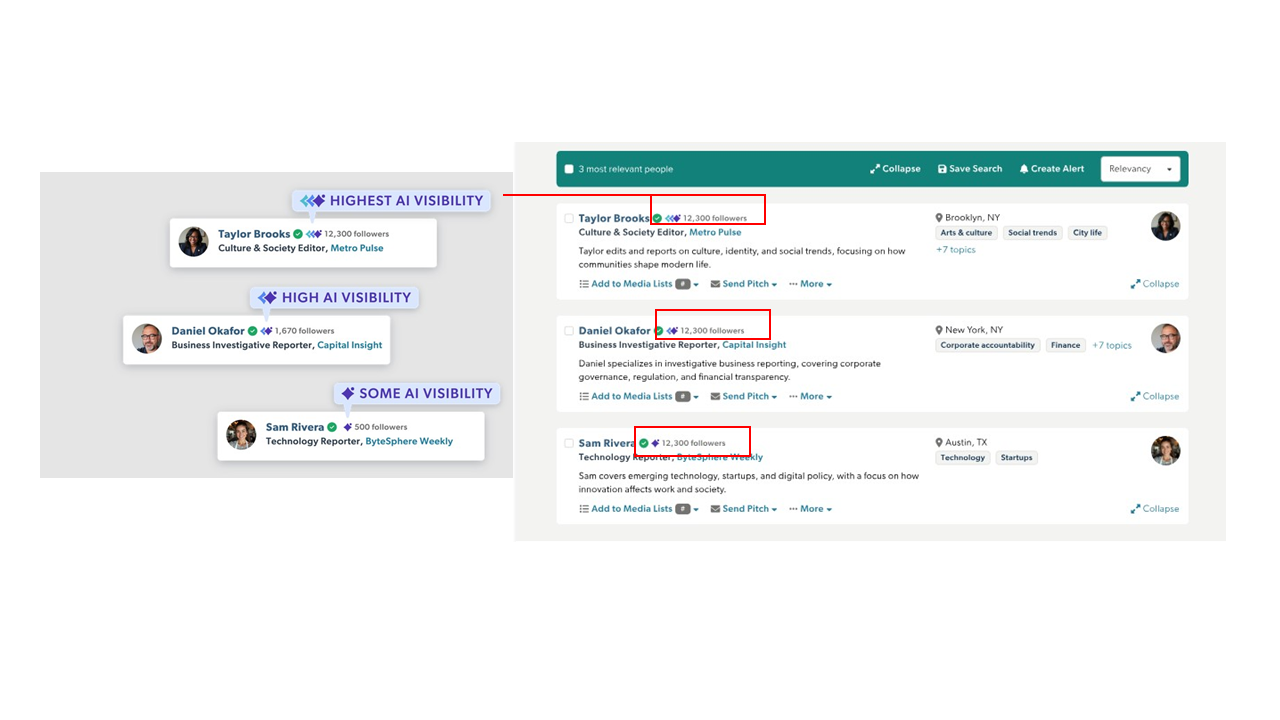
3. Onclusive finally sews its acquisitions together
About four years after buying Critical Mention, Kantar Reputation Intelligence and PRgloo, Onclusive has rolled out a unified platform. The unified platform combines the final product into four modules:
- Mention: Tracks where your brand is mentioned across news, broadcast and social media;
- Review: Create or manage press reviews or daily content;
- Contact: A database of journalists and influencers; and
- Measure: Analyze the impact of your coverage.
In 2019, prior to any M&A, I took a close look at its monitoring capabilities, which looked both thorough and expensive. Since then, Onclusive has gone through a lot of changes. It’s seen leadership turnover and hasn’t made much noise in the way of new product announcements or innovations.
The company is casting this announcement as a better user experience – rather than using separate tools, as in a best-of-breed approach. In reality, it’s joining a crowded and mature field of all-in-one PR software products. I also suspect the company’s brand recognition in the U.S. pales in comparison to the major incumbents in the PR software space.
4. PR tech briefs
- Meltwater makes it official with Reddit. Meltwater was granted Reddit partner status, which allows the company to continue accessing “Reddit’s enterprise data APIs” for media monitoring.
- Notified press release optimizer. Notified presents an AI Press Release Optimizer to “strengthen release drafts before distribution by improving structure, clarity, authority and quotability.” Notified owns GlobeNewswire.
- TV eyes a new media player. TVEyes announced an easier-to-use premium media player. The tool lets customers search, watch, clip, and analyze video and audio content with helpful features like thumbnail previews and transcripts.
- Semrush rebrands Prowly. SEO toolmaker Semrush rebranded Prowly, a PR software provider it acquired in 2020. Prowly is now the “Semrush AI PR Toolkit.” Rebranding an entire software company as a mere toolkit is quite possibly the most anti-climactic ending to an acquisition I’ve seen in the 7 years I’ve been writing about PR software.
- PRToolFinder filters for freebies. Tech directory PRToolFinder announced filters for users to find free PR software and free trials of PR software.
- Service providers turning software providers. Omnicom announced OMNI, an AI-powered system that pulls together data, technology, and expertise from across Omnicom (including after its merger with Interpublic) to help brands plan, create, buy, and measure their marketing more effectively.
5. New vendor survey data and reports
- PR inspiration. “86% of journalists say PR pitches inspire at least some stories, yet 88% delete pitches that miss their beat,” according to a survey of 900 reporters by Muck Rack.
- Change as an obstacle. 60% of PR teams surveyed “cite the rapidly shifting media landscape as their biggest challenge,” according to a Cision survey.
- AI use in PR needs no prompting. More than “90% of PR teams have already integrated generative AI into their workflows,” according to a survey by Meltwater.
PR software coverage for 2026
Here’s how to get on my radar if you are a vendor. At some point this year, I plan to write a separate and updated “comprehensive” list of PR software providers. I’ll likely place a query in Peter Shankman’s Source of Sources when I get ready to compile it.
* * *
Subscribe by email for free:
Check out my weekly blog posts, weekly podcasts, or a monthly newsletter via Substack that rounds up interesting reading from the last 30 days (examples).
If you enjoyed this post, you might also like:
5 takes on Gartner’s new optimism for PR and earned media in the age of AI