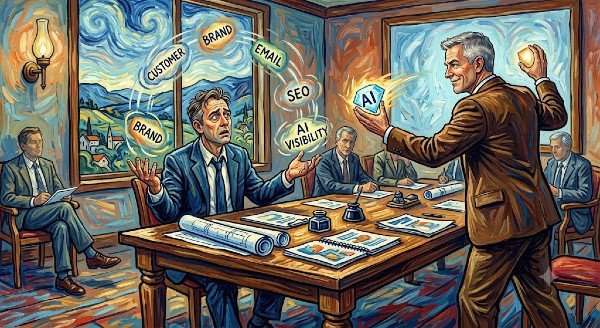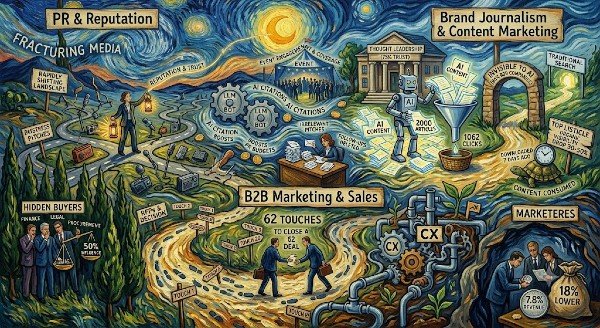
Mid-2026 data reveals AI delivering underwhelming returns while B2B marketing and PR grapple with fractured media, longer sales cycles, and the enduring value of trust and reputation
Regular readers know I spend a lot of effort on these pages sorting through studies in surveys. Now that we are halfway through 2026, I’ve taken some time to go back through all of the surveys I’ve covered here and on my Substack newsletter.
There are a few themes that stand out from a B2B perspective:
- Despite the hype AI has shown lackluster results;
- The media landscape continues to fracture meriting a strategic review;
- Businesses underinvest in trust and reputation but are slowly coming around;
- Marketing and communications are seeking human connection through events; and
- Longer sales cycles ought to refocus budget spending on efficiency and CX.
That’s my assessment after curating the statistics below from my work, stepping back and trying to think through what it all points to overall. Of course, you can and should draw your own conclusions by perusing the statistics below.
These are all neatly categorized into three sections:
- PR statistics;
- Content marketing (brand journalism) statistics; and
- B2B marketing statistics.
>>> Subscribe to receive thoughtful weekly blog posts by email
PR statistics halfway through 2026
1. The top priorities for PR in 2026. 561 PR professionals surveyed said their top priorities for this year are a) 73% brand awareness; b) 55% driving sales/revenue; and c) 49% improving PR measurement (source).
2. A good business reputation drives growth. Businesses that prioritize their reputation can deliver an extra 4.78% in annual shareholder value, according to a study by the global PR firm Burson. The firm assessed 66 publicly traded U.S. companies and calculated that the global value of business reputation is $7 trillion (source).
3. Event budgets grow for engagement and coverage. 93% of B2B event marketers expected their event budgets to grow in 2026, according to a survey by Event Marketer. Marketers have realized that in-person events drive customer engagement and earned media coverage (source).
4. AI citations boost PR budgets. “By 2027, mass adoption of public LLMs as a replacement for traditional search will drive a 2x increase in PR and earned media budgets,” according to Gartner (source).
5. Reporters rarely responded to pitches. More than half (54%) of reporters surveyed said they rarely responded to pitches. Why? Most pitches are not relevant. Nearly nine in 10 reporters (88%) delete pitches because they’re irrelevant to their coverage. That’s not the only reason why they might disregard a pitch (source).
6. Fewer reporters want follow-up pitches. 50% of reporters say one follow-up is ideal; 51% say follow-ups should happen between a few days after the initial pitch and up to a week later. This contrasts with findings seven years earlier, where 73% of reporters were open to follow-ups (source).
7. Challenges of a changing media landscape. 60% of PR teams surveyed “cite the rapidly shifting media landscape as their biggest challenge,” according to a Cision survey (source).
8. AI use in PR needs no prompting. More than “90% of PR teams have already integrated generative AI into their workflows,” according to a survey by Meltwater (source).
9. People don’t trust people who say, “no comment.” “When news consumers see or hear the phrase in a news story, 60% will question the story in some way, with 39% believing the person or organization is hiding something, and 35% saying it makes them trust the official less” (source).
Brand journalism and content marketing statistics halfway through 2026
10. Trust in thought leadership. 75% of decision-makers say that thought leadership is more trustworthy than many other types of content (source).
11. The unfortunate AI rule of thirds. 44% of AI citations come from the first 30% of the text in an article or blog post (source).
12. Invisible to AI. 96% of B2B companies are invisible in AI discovery (source).
13. Traditional search is still viable. 57% of B2B decision-makers use search engines during early research (source).
14. Bot traffic surpasses humans. Bots account for 57.3% of traffic compared with 42.7% for humans (source).
15. Prospects read downloaded content a week later. People who download content don’t read it until about a week later. The time between download and consumption grew from 38.5 hours in 2024 to 47.7 hours in 2025. That works out to 5.96 days, or about a week later (source).
16. Naming yourself in ‘top’ listicles depresses visibility. Websites with dozens of these self-aggrandizing ‘top’ listicles and found that search traffic has dropped noticeably: “In multiple cases, organic visibility dropped 30% to 50% within weeks. The losses were not domain-wide. They were concentrated in blog, guide, and tutorial subfolders” (source).
17. AI-generated content performs poorly. An experiment using generative AI to produce a whopping 2,000 articles and evaluating the results over 16 months found that all that AI content generated a measly 1,062 clicks (source).
B2B marketing statistics halfway through 2026
18. B2B marketing budgets are 7.8% of revenue. As a percentage of revenue, those surveyed saw a 1/10th of a percent in marketing budget increase, from 7.7% in 2025 to 7.8% in 2026. That’s “18% lower than the mean budget allocation just four years ago,” according to the firm (source).
19. It takes 62-plus touches to close a deal. The average B2B tech buyer required 62.4 touches on average, across 3.5 different marketing channels – from first touch to deal closed (source).
20. Hidden buyers influence B2B deals. Finance, Legal, and Procurement are hidden buyers that rarely show up in your sales or marketing funnel; however, they hold roughly 50% of total decision-making influence (source).
21. The prospective B2B buyer’s math. B2B buyers surveyed said they look at 7.6 vendors and whittle that down to 3.5 who make the short list. Those 3.5 who make the short list are likely to receive an RFP. In this survey, “buyers say the RFP response is the most critical factor in their final decision” (source).
22. Doubling down on customer marketing. 60% of businesses that took the 2026 CMO Survey are investing their budgets to sell more to existing customers. “This inward orientation is a consistent theme across the 2026 findings” (source).
23. No return on AI skills? 82% of B2B marketers say AI skills haven’t helped their paychecks (source).
24. Most buyers distrust sales prospecting. 61% of respondents say B2B buyers are less trusting of prospecting (source).
25. Peers are more trustworthy. 73% of B2B decision makers trust what their peers say about a company or product compared to 55% who trust vendor websites (source).
26. Where’s the return? 98% of CMOs invest in AI; just 1 in 3 see results (source)
27. Brands that improve CX grow. Brands that improve their customer experience (CX) are 2.5x more likely to grow (source).
28. What we have here is a failure to communicate. Nearly 50% of businesses fail to respond to a lead within 24 hours (source).
* * *
Subscribe by email for free:
Check out my weekly blog posts, weekly podcasts, or a monthly newsletter via Substack that rounds up interesting reading from the last 30 days (examples).
If you enjoyed this post, you might also like:
Not just seen, but believed: trust is the new mandate for marketing and comms