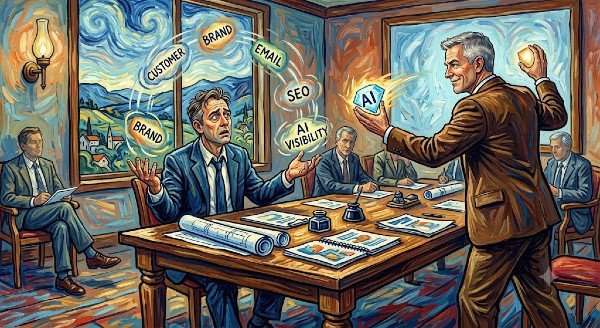
CMOs face a new ‘trilemma’ of delivering stronger growth with flat budgets while rapidly implementing AI; 70% of them are not ready
CMOs are accustomed to doing more with less, but now they’ve got another ‘more’ on their to-do list, according to Gartner.
Businesses have always wanted more results from marketing with less budget, but now they also want more results, with less budget while implementing AI.
That was one of the key findings coming from the analyst firm’s 2026 CMO Spend Survey (PDF). Gartner polled 401 senior marketers in the U.S. and Europe, who work for businesses with more than $1 billion in revenue.
As a percentage of revenue, those surveyed saw a 1/10th of a percent in marketing budget increase, from 7.7% in 2025 to 7.8% in 2026. That’s “18% lower than the mean budget allocation just four years ago,” according to the firm.
Those figures broadly match the findings from another recent survey of CMOs from the Fuqua School of Business at Duke University (PDF – see page 53).
In other words, businesses want better marketing results with the same budget – that much is old news – only now add in a directive to use AI:
“CMOs must simultaneously manage constrained budgets, rising growth expectations and pressure to deliver AI-driven transformation, with limited ability to optimize all three.”

Trading marketing headcount for AI
Gartner coined a cutesy term to go with it: trilemma. They define it as “delivering more with limited resources, meeting higher expectations and addressing an urgent mandate for AI transformation.”
That’s going to be a difficult task to complete, according to the survey:
- 70% of CMOs say their “marketing processes are not yet mature enough” to implement AI; and
- CMOs invest an average of 15.3% of their marketing budget in AI.
The survey didn’t appear to ask about data readiness, which is one of the biggest obstacles to scaling AI. Its veracity is also a long-standing issue in marketing.
So what?
“This imbalance is already impacting performance, with fewer CMOs reporting that they are exceeding their targets and more falling short across acquisition, retention and ROI.”
Yet balancing the imbalance has been the superpower CMOs have developed for years. Why does that matter now in an age of AI?
“As pressure intensifies, many organizations are slipping into a defensive posture at precisely the moment when bold action is required.”
Without more marketing budget, that bold action is going to be trading AI for headcount. That’s not bold; it’s irrational because marketing shops have been running lean on staff for the last 3-4 years.
There isn’t more headcount to give up. The data isn’t ready. The processes aren’t ready. We don’t even have a solid and impartial case study – a marketing transformation – for AI at this point.
In fact, we have the opposite. There are dozens of anecdotes now describing how business functions that have laid off staff for AI – development, quality assurance and customer support – are now hiring people again because the AI fell far short of the hype.
>>> Subscribe to receive thoughtful weekly blog posts by email
Use AI to scale customer connections rather than cut costs
One of the findings in the Garter survey that I think is pointed in the wrong direction is this one:
- 70% of CMOs say becoming an AI leader is a critical goal for 2026.
Being an “AI leader” isn’t a good marketing goal – that’s just ego.
People don’t buy products or stay loyal to customers because you are good at AI, they buy products because they solve problems. They don’t care if it works because of AI or pixie dust, so long as it does what the sales team promised.
They do care – and a whole lot – when they ask a question and no one responds. Or they fill out a form and wait a week to get a response. Or they call support and can’t get a human being. Or when they fill out a form and nobody responds.
The bold move here is to do the opposite of what every other business is trying to do with AI. Most businesses are trying to bluntly cut costs with AI. A better objective is to determine how to scale customer connections and margins, with modest ticks in budget growth.
If AI improves SME productivity by 25%, the question should be ‘where can that SME apply that 25% of time to add value to customers?,’ rather than ‘where do we cut to recoup the investment?’
AI ready marketing teams get more budget
The Gartner survey didn’t ask whether or not CMOs are seeing a return from their investment in AI. It’s probably too soon for that, but it’s something to keep an eye on.
However, it does provide some hope for CMOs. Those who get their marketing processes in order seem to receive a bigger budget for AI experiments:
- 30% of CMOs say they have “developed AI readiness capabilities”;
- This cohort invests 21.3% of their marketing budgets – about 6% more than peers – to AI initiatives; and
- They “also report average marketing budgets of 8.9% of company revenue” – that’s about 1% more budget.
Keep in mind, Gartner surveyed only businesses with a billion or more in sales, so that 1% more budget is a very large number.
* * *
Subscribe by email for free:
Check out my weekly blog posts, weekly podcasts, or a monthly newsletter via Substack that rounds up interesting reading from the last 30 days (examples).
If you enjoyed this post, you might also like:
The economic outlook for marketing from the latest CMO survey