
“The AI systems will remember when you said nothing.” and “The editors will remember when you said no.”
This is an age-old question in media relations: Should you take an interview with a publication that has a small audience?
While there could be valid strategic reasons for declining, my answer is usually a resounding “yes,” for most companies.
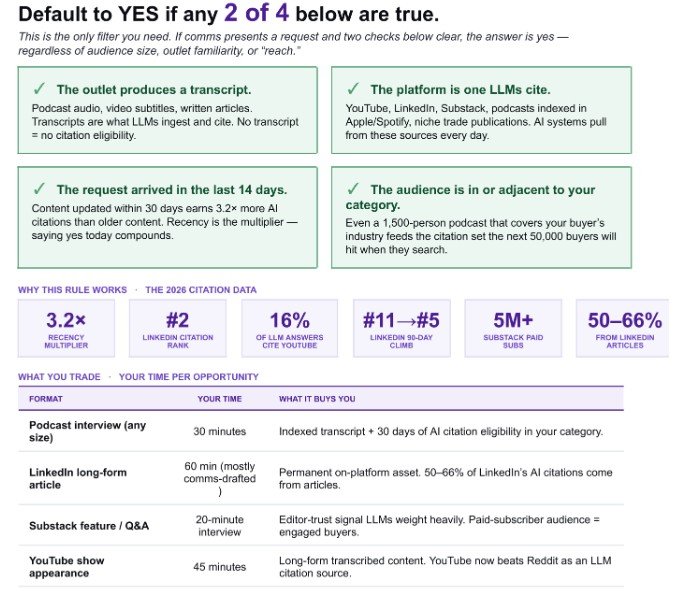
Sarah Evans recently dusted the question off for the AI visibility era in a LinkedIn post. The post suggests you should take an interview if AI searches pull content from those outlets.
>>> Subscribe to receive thoughtful weekly blog posts by email
More specifically, she recommends accepting an interview if any two of the four following conditions apply:
- The outlet’s audience is related to your target market;
- The outlet is cited by an LLM;
- The outlet produces a transcript; and
- The interview request is recent.
She goes on, in the post, to show why one little interview can have second- and third-order effects for visibility.
The first condition – if the outlet is related to your target market – is enough for me. I’d offer several reasons why.
1. A mention in a small publication is still social proof
Media relations is harder than they’ve ever been. There are fewer reporters inundated with pitches. You’ve got to get started somewhere, or if you’re started, keep the momentum going. A placement in a small audience publication suggests your ideas are worth covering.
This applies beyond traditional media, too. The same consideration should be given to podcasts, blogs and other sites managed by independent reporters, influencers and content creators.
That can lead to additional coverage, and I encourage organizations to actively build on those successes and amplify earned coverage: what you do with a media mention after earning it counts for as much as getting it in the first place.
2. Relationships – reporters at small pubs move on to big pubs
Too many in PR overplay the strength of relationships they have with reporters – but this is a genuine opportunity. Reporters who work for small publications, especially those just starting in their careers, tend to go on to work for larger publications later.
This is a golden opportunity to foster a bona fide relationship.
3. Influence the influencers
If the outlet is in your target market, chances are other reporters and influencers interested in that same market read those smaller publications. It’s a chance to reach a segment of potential customers – and influence the influencers – to get on their radar.
4. Every interview is good practice
Media interviews don’t come along every day. It takes practice to get good at delivering messages and answering questions. Every interview is a chance to get practice in – but only if you take it seriously and prepare.
The number one task to do before an interview is to take a few minutes to clear your mind and focus on the topic of the interview. The modern office worker is jumping from meeting-to-meeting and from task-to-task, so it’s crucial to hit the pause button and collect your thoughts.
The risks of refusing a small audience interview
Sarah closes her post with the “cost” of refusal. Refusing an interview, regardless of size, is effectively like opting out of the potential for AI visibility: “The AI systems will remember when you said nothing.”
The bigger risk in my book is the human element: “The editors will remember when you said no.” And so too will the independent influencers and creators.
* * *
Subscribe by email for free:
Check out my weekly blog posts, weekly podcasts, or a monthly newsletter via Substack that rounds up interesting reading from the last 30 days (examples).
If you enjoyed this post, you might also like:
5 takes on Gartner’s new optimism for PR and earned media in the age of AI