
The combination of two specialized technologies promises to provide comprehensive comms tools on a modern platform built for the era of AI
Two venture-backed PR startups announced today a “strategic partnership” that pairs media outreach with comprehensive monitoring. The announcement is being exclusively reported in the U.S. by this blog.
Propel, which is among the newest market entrants, has specialized in developing AI tools to assist comms pros with media relations. Signal AI is a pure-play media monitoring platform that has, in a sense, made a science out of reputation management.
In a statement emailed last week, the companies said:
“By combining real-time media intelligence with precision media targeting and generative personalized outreach, this partnership delivers a truly self-managed, end-to-end communications platform. The combined offering is already powering communication teams at major Fortune 500 companies spanning software, professional services and industrial automation.”
And a little further down, it noted:
“The partnership allows users to move effortlessly between two best-in-class platforms: Signal AI for real-time media monitoring and risk detection, and Propel AI for media list building, pitching, and ROI/productivity measurement.”
Propel CEO Zack Cutler elaborated in an email exchange prior to the announcement that, for now, the integration is limited to single-sign-on (SSO). However, “future integration around data and workflows” is on the product roadmap for the partnership.
For example, one use case could be adding a reporter to a media list, based on coverage spotted by Signal AI.
In terms of capabilities, according to the announcement:
“Signal AI’s proprietary AIQ engine analyzes over 5 million pieces of content every day – spanning news, blogs, broadcast, podcasts, social media, and regulatory filings across 226 markets and 75 languages – to surface communications and business opportunities, threats and emerging trends.”
Similarly, the capabilities Propel possesses include:
“Propel AI is the first Large Language Model built specifically for PR and communications teams, trained on 25 million real PR pitches, 500,000 journalist profiles, and 2 billion articles. With AI-crafted email personalization, seamless Gmail/Outlook/Slack integration, and granular ROI analytics, Propel users typically double response rates, generate a tenfold increase in organic backlinks, and reclaim over 20 hours per week.”
Collectively, the companies say the joint benefits the partnership provides to customers are as follows:
- “Monitor global media narratives in real time using natural language prompts.”
- “Receive early alerts on reputational risks, coverage spikes, or regulatory changes.”
- “Discover and engage the right journalists from a dynamic, AI-powered media database.”
- “Generate and send hyper-personalized pitches, with engagement tracking built in.”
- “Move seamlessly across monitoring and outreach with single sign-on.”
- “Measure true impact and campaign ROI.”
What led to the partnership?
Cutler said:
“Signal and Propel have been aware of each other for a while – we share a similar vision of bringing true AI innovation to an industry that’s been slow to evolve. Our teams began talking earlier this year and quickly realized how complementary our technologies are.
Signal leads the world in reputation and risk intelligence; Propel leads in AI-driven media database and workflow automation. The partnership came naturally once we saw that combining the offering could deliver a complete, AI-native workflow for communications teams.”
Where should customers or prospective customers start?
Customers of either company can explore the product offering of the other with their existing account manager. For example, your Signal AI account manager can assist you with adding Propel and vice versa. If you are new to both companies, either company can serve as the starting point.
Cutler said in an email:
“Both teams are aligned to ensure a smooth, unified experience.”
Is Propel changing its name from Propel PRM to Propel AI?
Observers may have noticed Propel used to refer to itself as “Propel PRM” (public relations management), and in this announcement, it refers to itself as “Propel AI.”
According to Cutler:
“The PRM name reflected our early focus on workflow automation. As the product has grown into a fully AI-native platform with its own LLM and deep data capabilities, Propel AI better represents what we do today. The transition will roll out gradually across our materials and website over the coming weeks.”
(click image for higher resolution)

“AI-native pioneers” in PR software
Both organizations claim to be “AI-native pioneers,” which is part of what makes this partnership stand out. Most of the incumbent vendors in the PR software market were built before ChatGPT blazed on the scene in late 2022. Since that time, many have rushed to add generative AI tools to their existing platforms, where these two startups have designed their platforms for AI from the get-go.
One of the ways AI makes the software different from a UX perspective is the user interface. In addition to the standard interface of pointing and clicking and filtering, the software reacts to prompts. In the screenshot nearby, with the list of journalists, notice that the Propel software is responding to a user prompt in the top right-hand corner.
Other vendors, including Signal AI, have rolled out similar functionality with chatbots. We may well be in the midst of a behavior change where all of our interactions with software products are based on AI prompts rather than clicking around with a mouse.
“This is a turning point for the communications industry,” said David Benigson, founder and CEO of Signal AI, in the written announcement. “Signal provides the world’s most powerful AI solutions for reputation and media intelligence. Propel delivers the most advanced PR outreach tools and the first AI-powered media database. Together, we’re building the future of comms.”
Propel initially used generative AI technology from OpenAI, but it has switched to its “own proprietary model” built on the open-source Llama architecture championed by Meta, Cutler said in the email exchange. The company still uses self-hosted versions of other AI models, including OpenAI and Gemini, “for some content and research use cases.”
He emphasized that his company’s large language model (LLM) is fine-tuned to meet the specific needs of PR and communications professionals.
“Unlike general-purpose models like GPT or Gemini, Propel’s model is purpose-built for the communications industry – it doesn’t just generate text, it understands context, timing, and tone in how journalists and PR teams actually interact,” he explained.
Propel also previously checked the “all-in-one” (media database, distribution and monitoring) software block by partnering with LexisNexis for print and TVEyes for broadcast monitoring. In the email exchange, Propel’s CEO said those partnerships remain active.
Signal AI said in an email, its AI “architecture is model agnostic.” That means the company isn’t tied “to any specific foundational model provider and is always able to leverage the best models currently available for the task. It added, “this extends to ‘chaining’ different models when required.” For example, “having one model evaluate the outputs of another.”
The company says this approach enables them to provide two key features:
“1. Blending discriminative models with generative ones. Signal has 10+ years of experience in developing and training proprietary discriminative models to capture aspects such as entities and topics mentioned in the content we analyze, their salience and sentiment towards them, anomaly and risk event detection, clustering, relationships between concepts discussed and others.
This means the data and metadata we ‘feed’ into generative models is truly unique in the market and the responses blend qualitative and at-scale quantitative insights (something any of the top 5 general-purpose generative engines can’t match).
Additionally, our unique approach to information retrieval (identifying information relevant to the user question in a vast corpus of content) means our retrieval augmented generation (RAG) systems reach 95% citation accuracy, much higher as compared to industry norms.
2. Embedded expertise. Our agentic systems, such as Ask AIQ, are specifically trained for decision-making by domain experts in reputation and risk intelligence, meaning their choices and reasoning explicitly mirror those of human experts.”
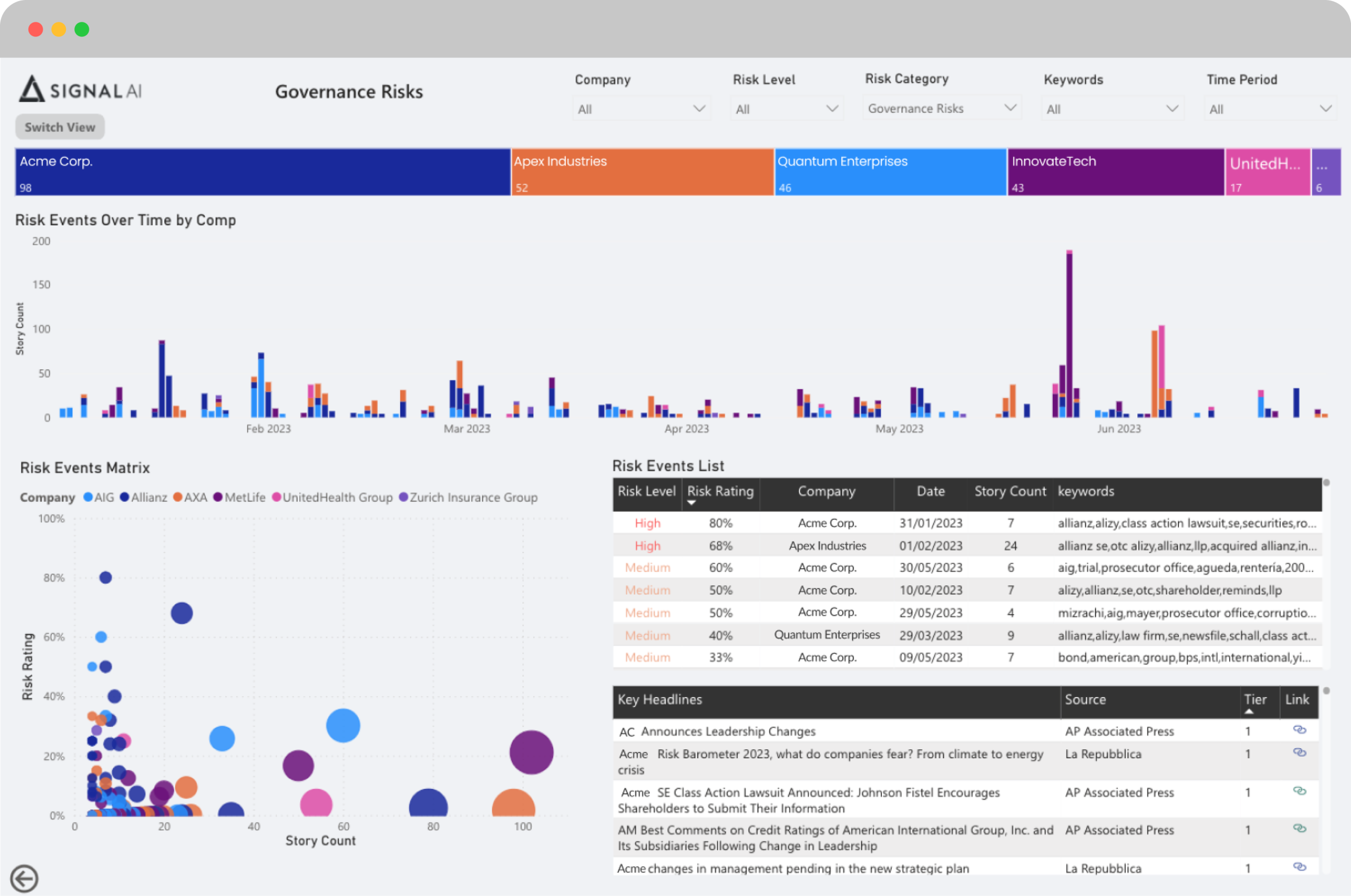
Agentic is a bit of a buzzword in AI. It means that AI is acting like an autonomous agent that works on your behalf. The screenshot below depicts a dashboard view within Signal AI.
(click image for higher resolution)
A PR agency owner turned software CEO
I’ve watched both companies evolve over time and have spoken directly with both CEOs over web conferencing calls and web demonstrations in the past. Both founders have quintessential startup stories.
Cutler is a former PR agency owner and grew his firm to $1 million in revenue. He got interested in developing technology when he felt none of the PR software tools met the needs of his team. His interest grew to the extent that he sold his firm and went all in on software and started Propel.
His history of working in PR, especially as an agency owner, counts for a lot in my book because he has experienced the challenges of PR work firsthand. Many of the incumbent vendors didn’t even have PR on their in-house teams until recently.
I believe experiences like that show up in the software. One of the things that stands out to me about Propel is the email client plugins. These allow you to work in an email client, like Outlook or Gmail, while maintaining an accounting of activity. This allows PR pros to continue their work without changing their process. By contrast, most rivals require you to cut and paste pitches and releases into their platform to keep tabs on outreach.
This might seem like a small detail, but it’s understanding those details that enables a company to create a good user experience. The company has raised $6 million in venture funding over two rounds, according to Traxcn.
A garage venture now with deep pockets
Signal AI has seen more explosive growth. The company is fresh off a $165 million Series E round by Battery Ventures, which took a majority stake in the company. The company has raised some $268 million over seven rounds, Traxcn reports.
Such deep pockets are a long way from the garage where the company was founded. Benigson was trained as a lawyer early in his career, and it may well be that experience that led him to the ideas of issues and reputation management.
In a call and short demonstration in 2022, he explained the company’s approach using regulations as a framework. Regulations start out as sentiment – a variety of media monitoring tools are good at capturing this initially. However, these grow into discussions and then news and eventually reputation issues and possibly regulations.
There are so many issues to worry about, it’s hard to know which ones merit the comms team’s focus. Signal AI strives to monitor those issues and quantify the impact, which will help prioritize your focus – and know when an issue merits flagging for leadership.
This partnership bodes well for the PR community
Just last week, a subscriber to this blog wrote to ask me for PR software platform recommendations. He wasn’t unhappy with his current provider but wanted to know if there was anything new out there. Propel has been on my list of software providers I recommend exploring for a couple of years now – and I think this partnership bodes well for the PR community.
If these two companies can execute on this partnership, if they can play well in the proverbial sandbox together, they have the potential to be a very viable, competitive, and modern alternative.
Although neither company said this to me, and it’s purely speculative on my part, partnerships can be proof-of-concept, of sorts, for working closer with each other in the future. While I’m not one to get excited about exclusives, I agreed to this one because, knowing a bit about these two companies already, the partnership made sense to me.
If this partnership gets traction, it wouldn’t surprise me if a closer relationship grew out of this announcement.
Note: I’ve invited Zach and David to join me on a future episode of the B2B Marketing and PR podcast to tell us a little more about the partnership. I’ll likely post the transcript here if that comes to fruition.
Subscribe by email for free:
Check out my weekly blog posts, weekly podcasts, or a monthly newsletter via Substack that rounds up interesting reading from the last 30 days (examples).
If you enjoyed this post, you might also like:
Will AI replace PR people in the next 10 years? Answers from 13 PR software executives