Most marketers believe the marketing budget will grow modestly next year; marketing spend for next year themes center on AI, CX, and improved targeting
The term “economic uncertainty” has been the phrase of the year for the last several. A mix of conflicting economic indicators has perpetuated it and perhaps, leading many to feel the term is tired.
Yet the reality persists and businesses dislike uncertainty. Most respond with three basic responses – fight, flight or freeze – depending on their view of the world.
As marketers, it’s our job to strive to see around the corner and prioritize spending that will drive growth. It’s useful to consider where our peers are considering spending their budgets next year.
So, last weekend, as has become my custom, I took a wide-angle lens to five recent surveys – all conducted within the last six months – to see where B2B marketing plans to spend its budget in 2026.
Below is what I found; I’ve got some considerations for your own planning at the bottom.
1. Budgets will grow; spending on content, AI and CX
The B2B marketing agency Sagefrog, which has five offices in the northeastern U.S., is out with its 19th annual survey of marketers. The agency polled “nearly 500” marketers across eight industries, including healthcare and life sciences (21%) and being software and technology (6%) – and published it’s 2026 B2B Marketing Mix Report in October of 2025.
A comfortable majority of marketers (70%) expect their budget to grow. Another 17% expect them to be flat and 13% expect a decrease. The report says the top marketing priorities, in order, are brand awareness, lead generation, sales support and client retention.
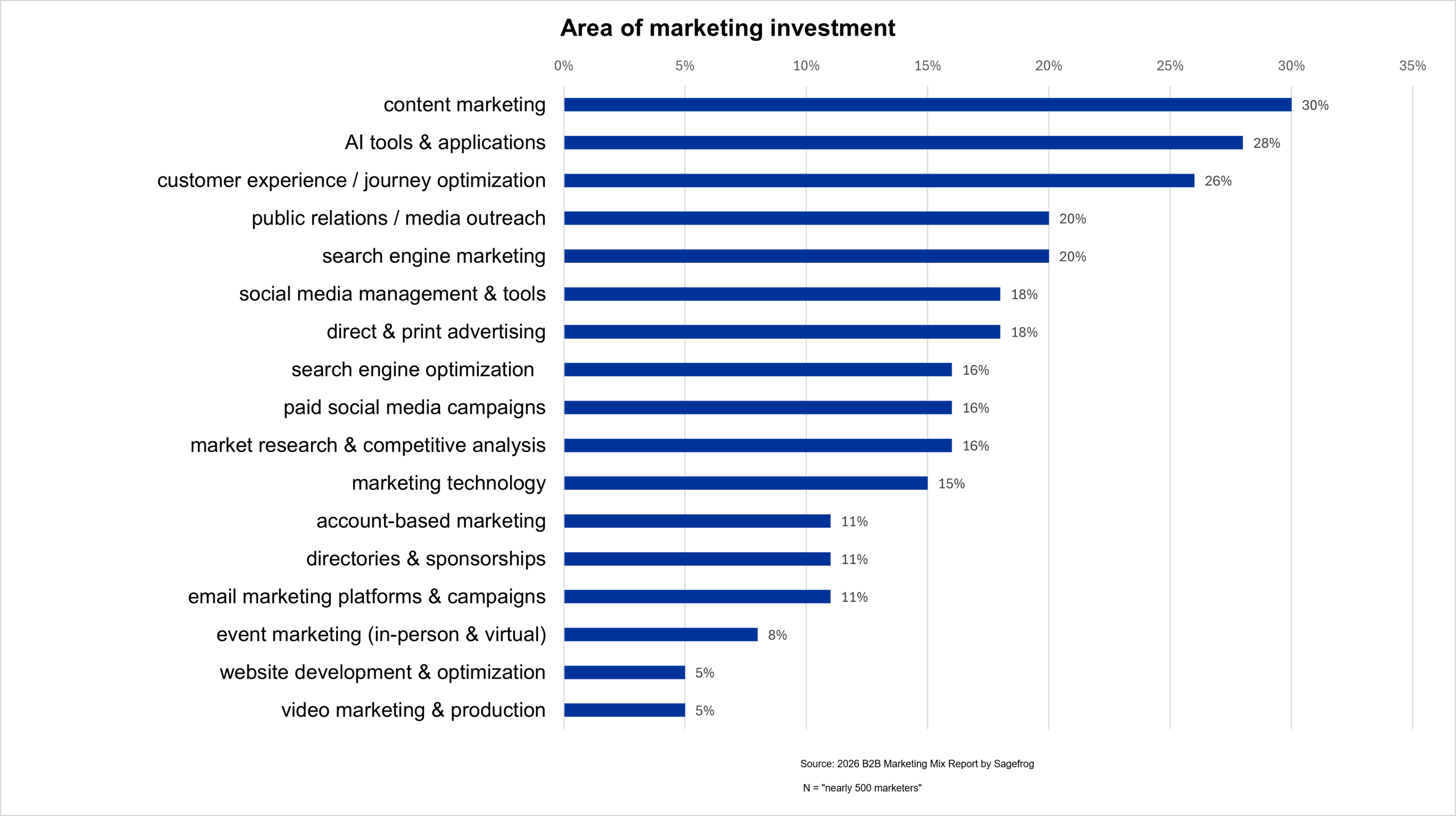
Here’s where respondents said they plan to invest their marketing budget to achieve those priorities:
- 30% said content marketing;
- 28% said AI tools & applications;
- 26% said customer experience / journey optimization;
- 20% said public relations / media outreach;
- 20% said search engine marketing;
- 18% said social media management & tools;
- 18% said direct & print advertising;
- 16% said search engine optimization;
- 16% said paid social media campaigns;
- 16% said market research & competitive analysis;
- 15% said marketing technology;
- 11% said account-based marketing;
- 11% said directories & sponsorships;
- 11% said email marketing platforms & campaigns;
- 8% said event marketing (in-person & virtual);
- 5% said website development & optimization; and
- 5% said video marketing & production.
(click image for higher resolution)
2. Investing “more algorithms to serve” than the team
MarketingProfs and the Content Marketing Institute team up every year to poll members of both communities for their annual survey. They recently published its 18th annual B2B Content and Marketing Trends Report for 2026.
The report is based on input from 1,015 B2B marketers who are largely based in North America. There is no indication that I could see whether respondents anticipated their marketing budget going up or down. However, the survey did ask respondents to identify the “top three areas they plan to increase investment in during 2026.”
Here’s how their answers stacked up:
- 45% will invest more in AI-powered marketing tools;
- 33% will invest more in events and experiential marketing;
- 32% will invest more in owned media (website, blog, email);
- 25% will invest more in paid media;
- 24% will invest more in content personalization;
- 21% will invest more in tech infrastructure (martech, analytics, CRM);
- 20% will invest more in social/earned media;
- 19% will invest more in agency/outsourcing;
- 15% will invest more in research and insights;
- 12% will invest more in first-party data capabilities; and
- 9% will invest more in human resources (salaries, T&D).
(click image for higher resolution)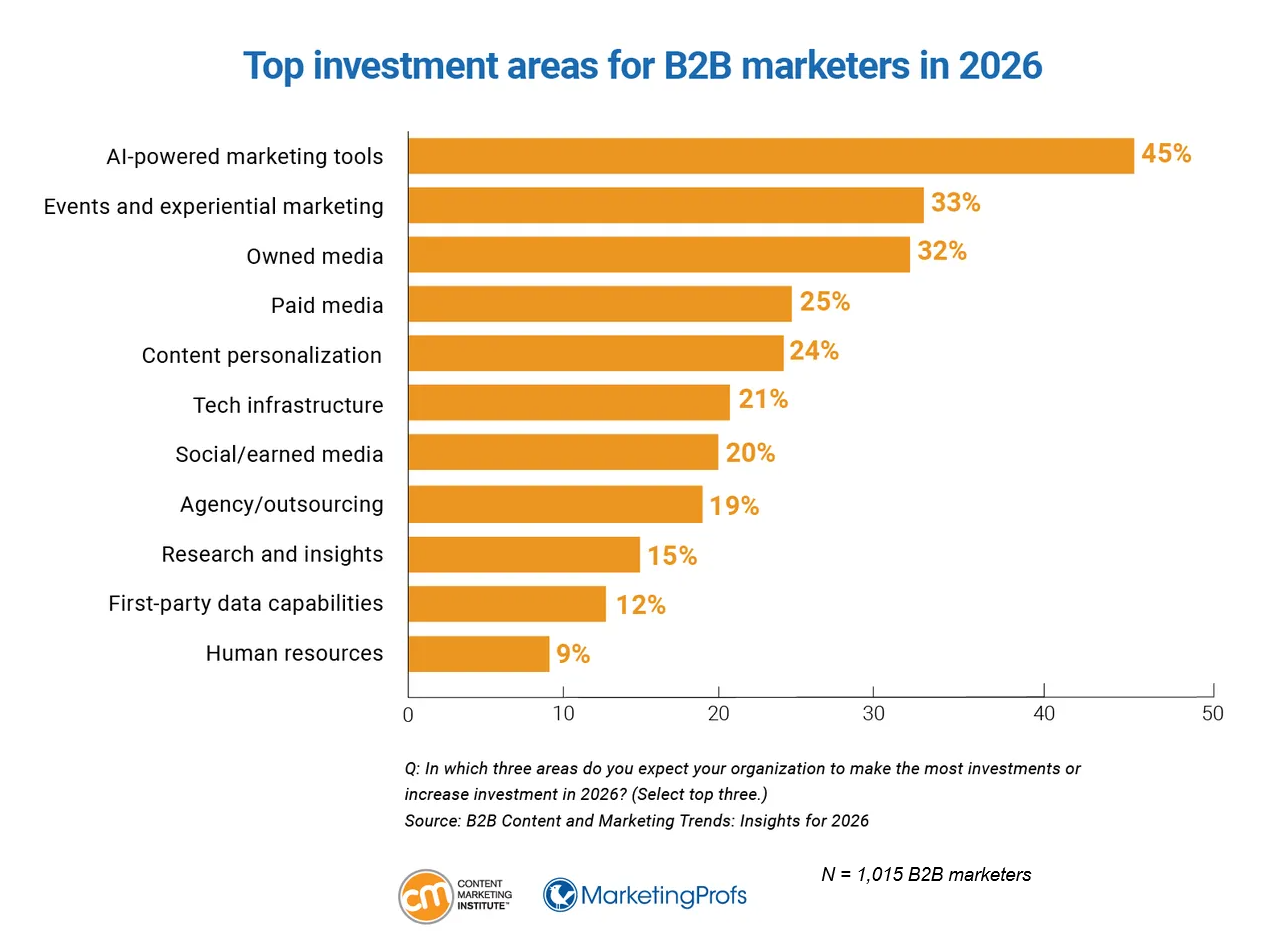
Robert Rose, who penned “takeaways” from the survey, paints these proposed investments as both good and bad news.
The good news?
“After years of underinvestment, marketers are finally putting weight behind the channels they control — the events, communities, and content platforms that build long-term trust.”
The bad news is that investment in those resources that are human is dead last:
“So, organizations pour money into more buttons to push, more algorithms to serve, and more content to churn, but hesitate to invest in the people who make the strategy real. This is a mistake.”
3. Demand marketers double down on targeting and quality
There’s a lot of discussion about brand versus demand in marketing. It’s being driven by “zero-click,” which is the fact that fewer people are clicking through to source links in search and in responses to generative AI prompts.
Clicks are essential to measuring the effectiveness of demand generation and the so-called “performance marketing.” To that end, it’s useful to see what marketers focused on demand generation are thinking about.
Activate, an agency focused on demand generation, partnered up with Marketing Charts to survey 239 “qualified” marketers working in demandgen or tech marketing. The report, published in October of 2025, found lukewarm views for budget growth:
- 8% expect budget to “grow significantly”;
- 24% expect budgets to “grow somewhat”;
- 46% expect budgets to “stay flat”; and
- 12% expect budgets to “decrease.”
The survey also asked about investment for next year. “In the coming 12 months, which demand generation tactics/channels do you expect to increase the most? (Select up to 3)”
Here is how the answers were broken out:
- 48% said account-based marketing (ABM) programs;
- 31% said live events;
- 30% said lead nurturing;
- 28% said high-quality lead programs (late-funnel, HGL/SRL);
- 22% said social (including LinkedIn thought leadership);
- 20% said email marketing;
- 20% said online events (e.g. webcasts);
- 18% said display/programmatic advertising;
- 18% said paid search;
- 16% said content syndication;
- 16% said inbound marketing (on your corporate website); and
- 6% said other.
(click image for higher resolution)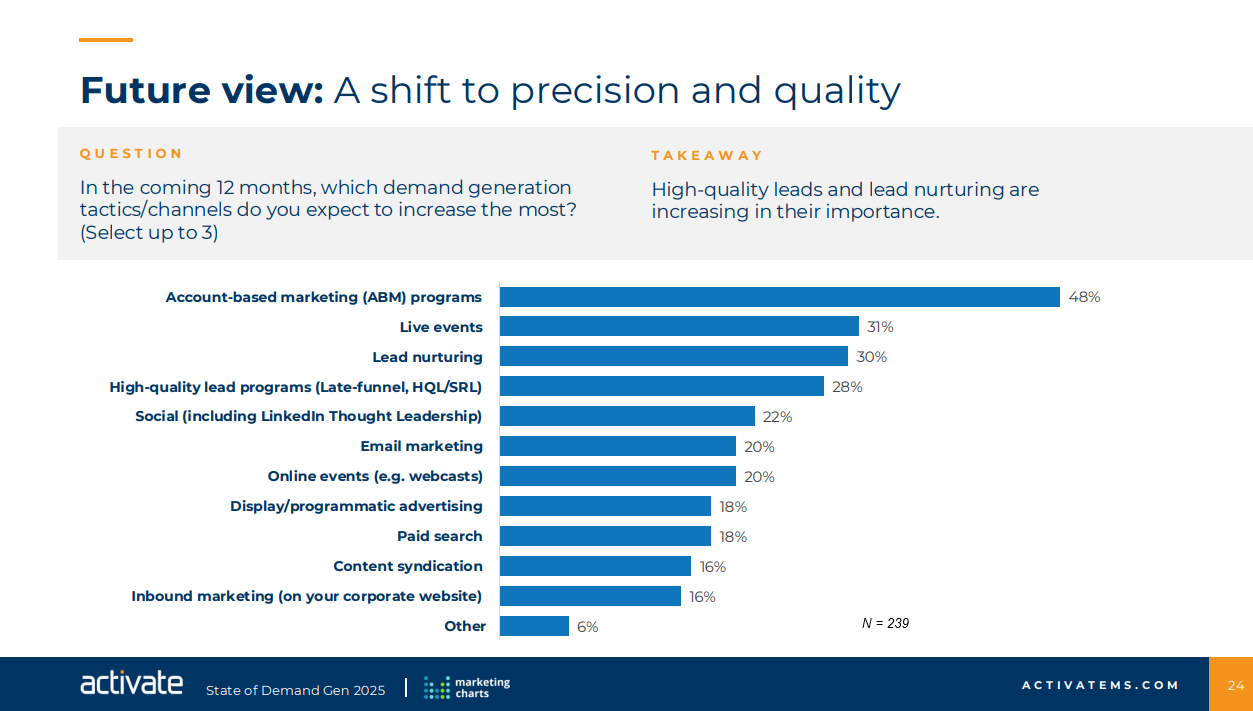
The survey also asked respondents to identify which content types are most effective based on the marketing stage – top, middle or bottom of the funnel.
- Most effective content types at the top of the funnel: videos, blogs, white papers, live events, research infographics and podcasts;
- Most effective content types at the middle of the funnel: case studies, webcasts, white papers, solution briefs, virtual events and research; and
- Most effective content types at the bottom of the funnel: case studies, ROI calculators, live events, white papers and solution briefs.
(click image for higher resolution)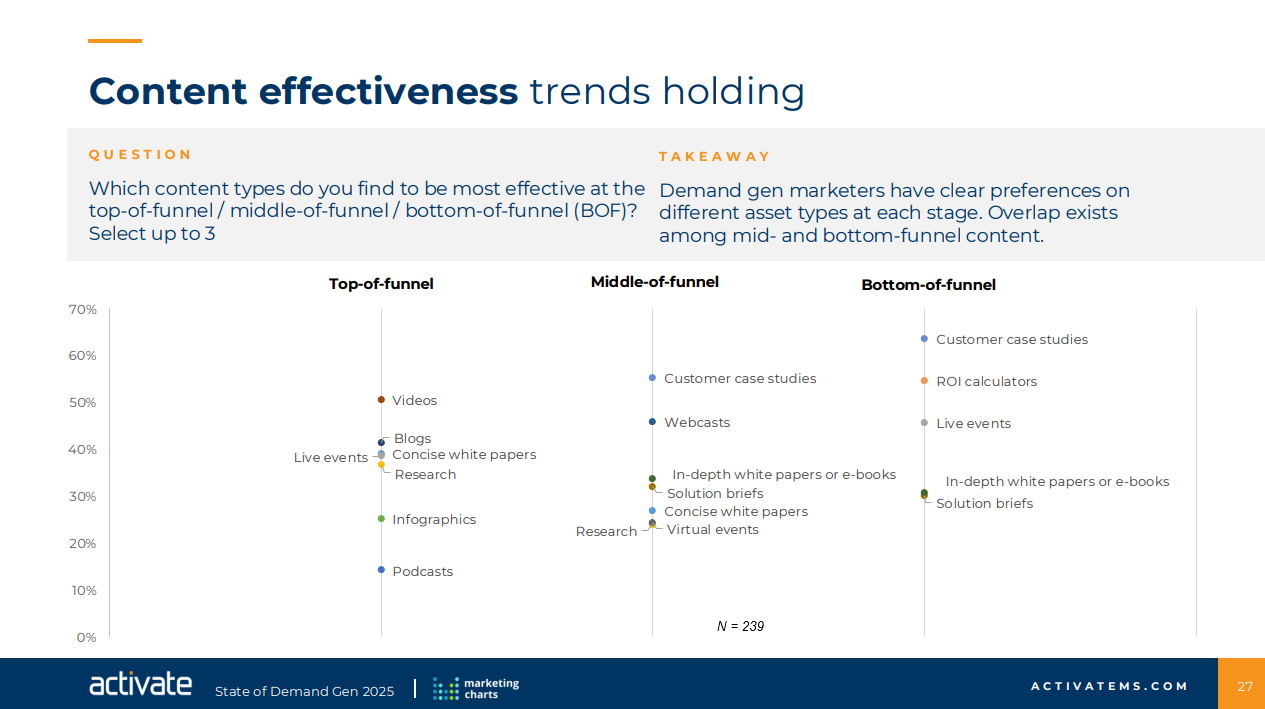
4. European marketers look to AI, CX and data
The U.S. tends to be inward focused, and I find it useful to look around and see what Europe has on it’s mind. For this, we turn to the CMO Barometer 2026 by Serviceplan Group, University of St. Gallen, and Heidrick & Struggles.
The three organizations teamed up to poll 805 marketers in Europe with an average of 21 years of experience. They work in more than a dozen different vertical markets; 27% of respondents work in B2B; 30% in B2C; and 42% say they work in both.
Budget expectations are split into (rough) thirds:
- 31% expect budgets to rise, including 17% who say theirs will grow by 5% or more;
- 38% expect budgets to remain flat; and
- 30% expect budgets to shrink, including 17% who say it will shrink by 5% or more.
Optimism about marketing budgets depends on where you are in Europe. For example, respondents from the UK, Italy, Netherlands and the Middle East were the most optimistic, while Switzerland, Spain and France were more or less neutral. Austria was negative.
The survey did not explicitly ask respondents where they plan to invest; rather, they asked about “hot topics” in marketing and important trends. Both questions provide a sense of what marketing in Europe is thinking about for next year.
First, the survey asked, “In your opinion, what is the hot topic for the marketing year of 2026?”
- 68% said AI & automation;
- 17% said brand building;
- 8% said personalization;
- 8% said social media & community building;
- 7% said digital transformation;
- 7% said data & analytics;
- 7% said privacy & trust;
- 6% said ROI & performance;
- 5% said sustainability & ESG;
- 4% said customer experience;
- 3% said content production;
- 3% said creative effectiveness; and
- 3% said other.
(click image for higher resolution) 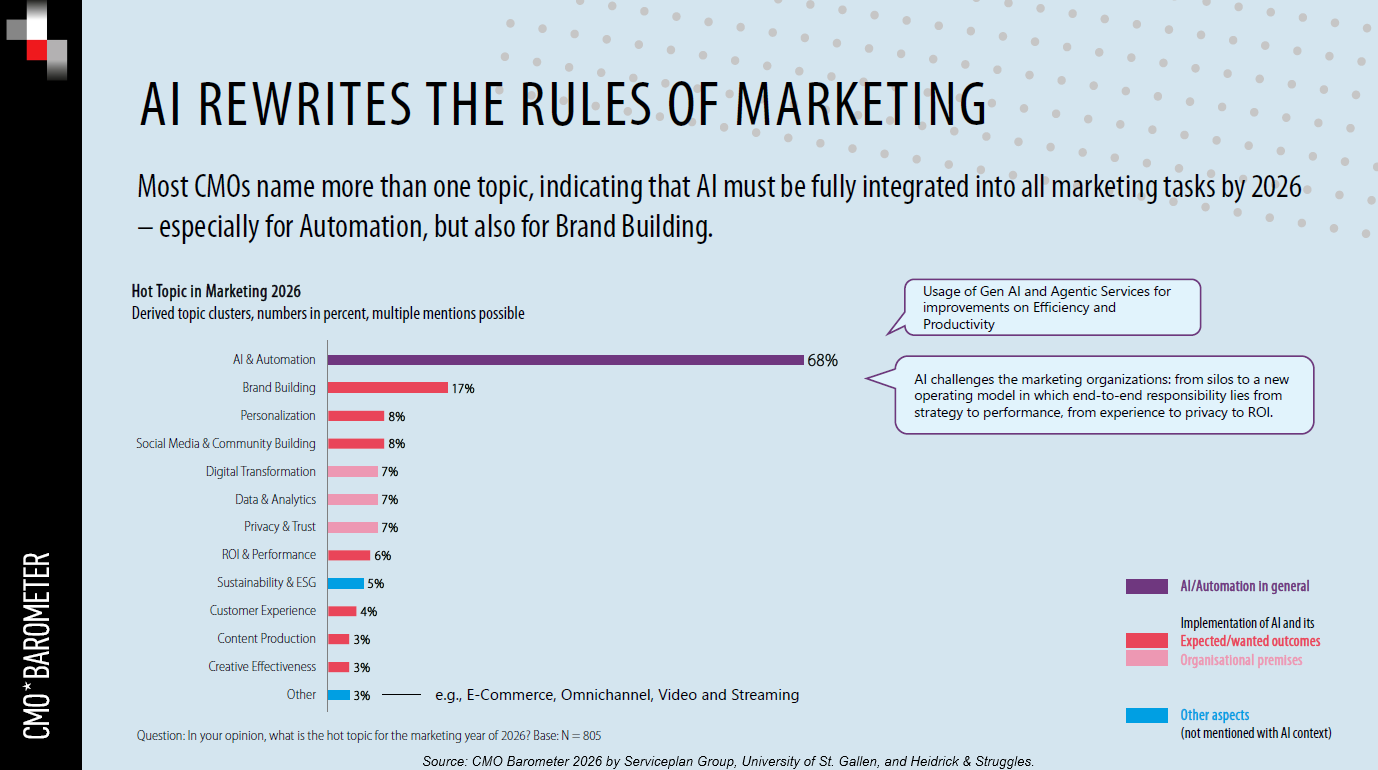
Then it asked about trends, which places some of these hot topics into areas of marketing focus. Marketing trends that respondents believe are important for 2026 include the following:
- 87% said use of AI in marketing processes;
- 83% said CX, personalization and improvement of the customer journey;
- 80% said data-based marketing;
- 78% said marketing ROI / marketing controlling / marketing analytics;
- 77% said emotional brand building;
- 65% said social media and influencer marketing;
- 64% said performance marketing (i.e. SEM); and
- 63% said e-commerce / social commerce / connected commerce.
(click image for higher resolution)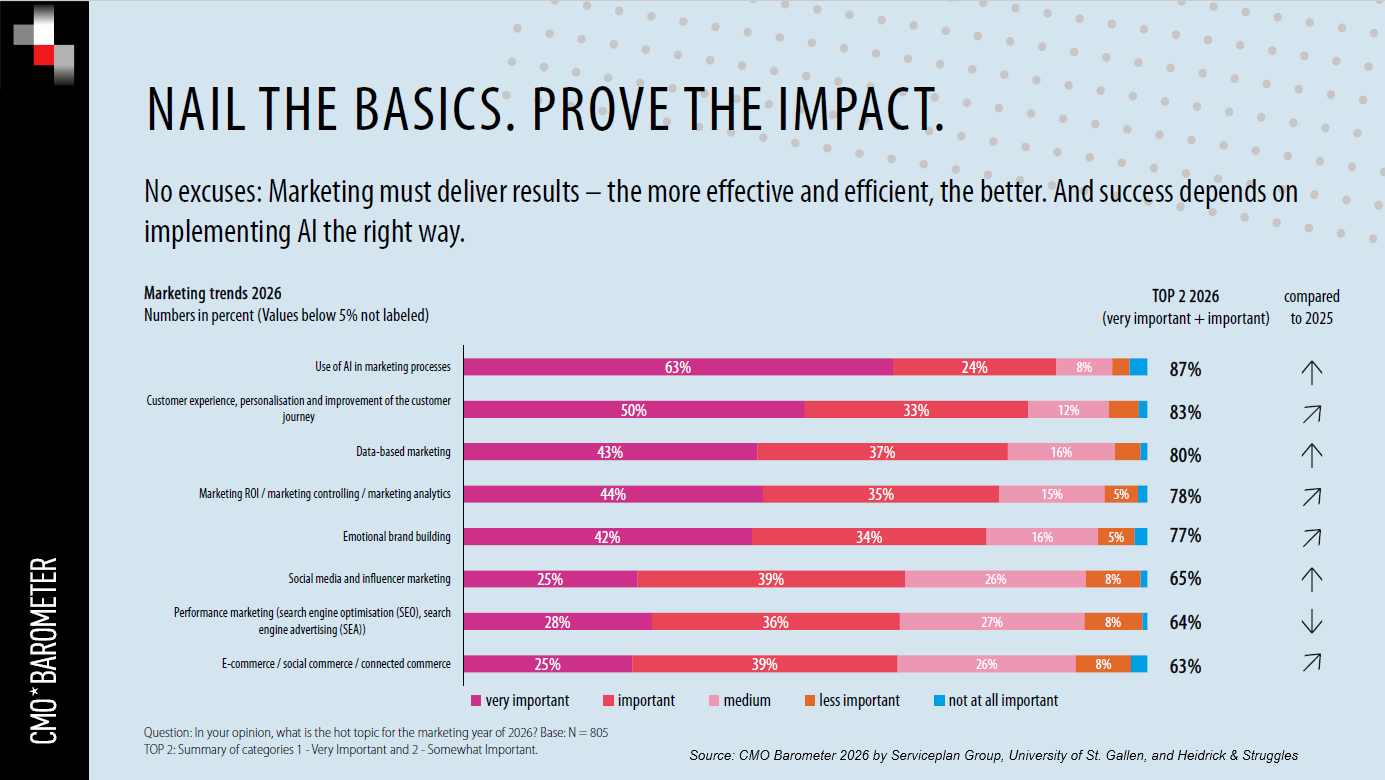
The full report slices a lot of the responses out by vertical market and by country. If you are based in Europe, or do marketing work in Europe, it’s worth taking a closer look at this report.
5. Marketers for banks look to digital channels
The ABA Banking Journal polled 83 marketers in June and July of 2025 to ask about marketing investments. This is an interesting take on marketing spending because banking is a regulated market. Among the high-level findings was this:
“Consistent with last year’s survey and with general advertising industry trends, digital media such as display advertising and paid search will receive a larger share of the advertising pie. Direct mail tops the list among traditional or analog channels in terms of investment, probably because its financial impact is also measurable.”
The survey quantified how marketers promoting banks divide their budget along three lines in 2025:
- 32% of budget was dedicated to new customer acquisition;
- 22% of budget was dedicated to customer retention; and
- 12% of budget was earmarked for outside agencies.
Obviously, those numbers don’t add up to 100%, so there’s another 34% of the budget dedicated to activities that don’t fit into one of these buckets.
When asked, “Where do you anticipate increasing your marketing budget for next year?” the top answers tallied up like this:
- 82% said digital advertising;
- 63% said SEM or SEO;
- 46% said social media;
- 31% said email;
- 29% said website maintenance;
- 27% said content marketing;
- 23% said with ad agencies; and
- 23% said direct mail.
(click image for higher resolution)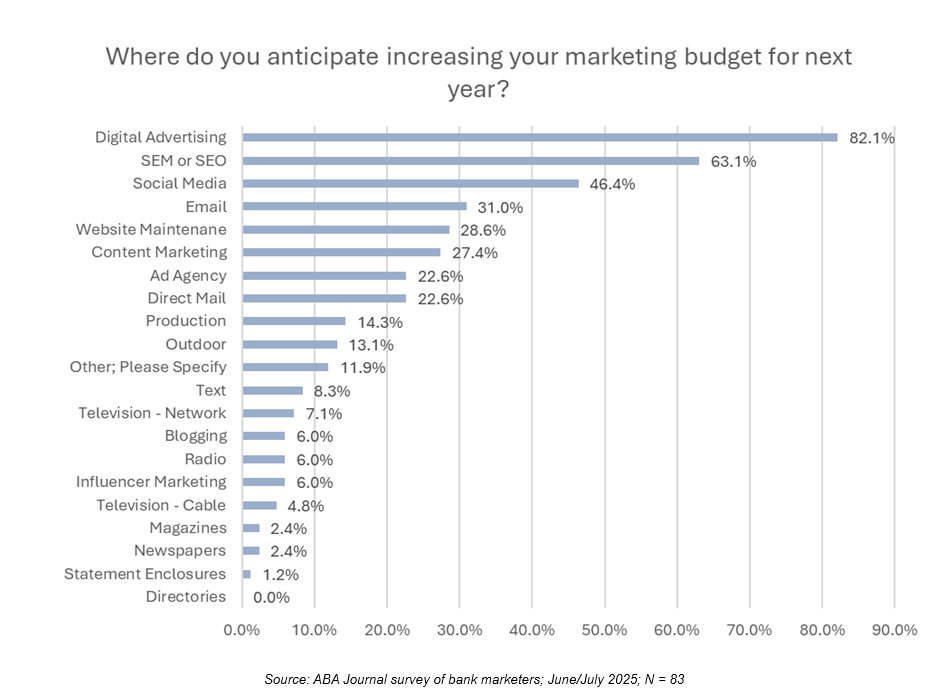
I do have a couple of caveats on these answers. First, SEO and SEM are two different things. I would bet that most answered this question as more spending on PPC ads, which lands in the search engine marketing (SEM) bucket.
Second, something similar is at play with the reference to ad agencies. Agencies focused strictly on advertising are just one type of service organization. Here again, I would imagine respondents answering for all agencies, including marketing, creative, PR and search-related service providers.
Two key considerations for B2B marketing spend
I’ll close this post with two considerations to incorporate in planning your own marketing budget. First, take a look at your overall marketing performance and strive to understand where you are weakest.
For example, is it a bigger challenge to get awareness for your product or company – or is it closing deals? Marketing shops will address each problem differently and spend money differently to address these very different shortcomings. The chart from the Activate survey in the third item above is instructive here.
Second, look at what performed well for you last year. Several of the studies mentioned above asked respondents which tactics produced the greatest returns. It’s useful to examine the results for your own organization, too.
The decision is still a vexing one to tackle: do you double down on those areas performing well, or do you trim those line items and reinvest that money into an under-performing area? The best answer is probably the one you believe will have the most impact on your business.
* * *
Subscribe by email for free:
Check out my weekly blog posts, weekly podcasts, or a monthly newsletter via Substack that rounds up interesting reading from the last 30 days (examples).
If you enjoyed this post, you might also like:
How many touches or interactions does it take to attract and close B2B prospects?
Image credit: Google Gemini and respective studies