
If we’re having trouble proving the value of PR today, it’s only going to get harder with something as ghostly as AI visibility metrics
Muck Rack is out with a new survey on PR measurement. The software maker polled 832 respondents, and one section of the survey is dedicated to AI visibility.
Here are some of the findings:
- 53% of PR pros surveyed believe AI will have a major impact on PR measurement over the next two years; another 40% say it will have a minor impact;
- 64% say AI search visibility has the most potential for improving PR measurement (see graphic nearby);
- 48% of respondents say tracking AI mentions is “extremely important” (20%) or “very important” (28%);
- 37% say LLM visibility will become a standard PR metric in the next 2–3 years; and
- 28% have taken steps to measure brand mentions in LLMs and another 33% plan to do so.
My question is, how are you measuring brand mentions in AI or LLMs?
We can certainly see the impact in one-off examples and screenshots, but I haven’t seen anything that can do this at scale. So, I put that question forward because I don’t think there’s a reliable way to measure this yet.
(click image for higher resolution)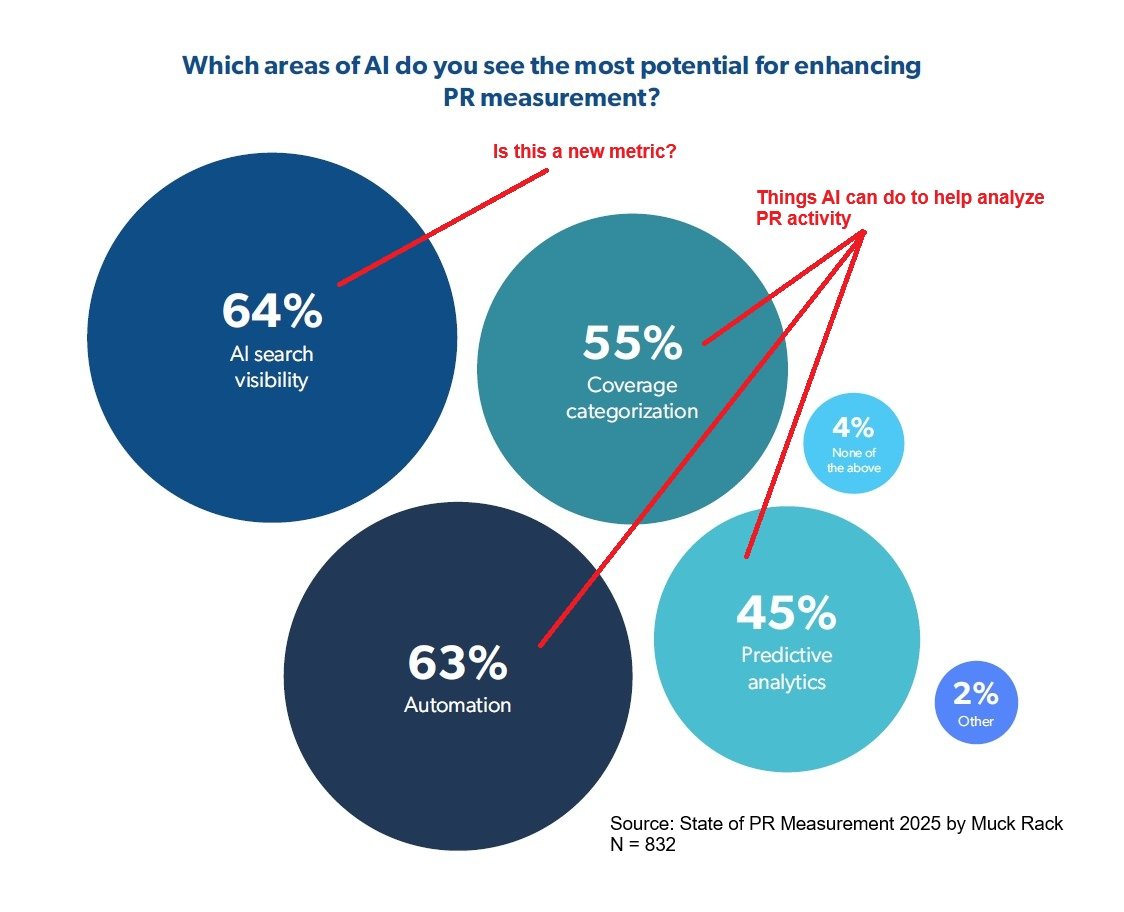
A page from SEO tools
There are a few SEO software tools that claim to measure the visibility of AI overviews in Google, but I haven’t seen one that claims to measure how many times a brand is mentioned in AI chatbots. These are not the same things.
I’d posit there are only two ways to get that data. The first option is to get a count from an LLM. You’d need to get that it from all of the major AI tools – ChatGPT, CoPilot, Perplexity, and Grok for example. It’s possible that it could be an option in the future, particularly if LLMs package a data feed like this for sale to PR monitoring software.
It would be even better if the monitoring software receiving this feed could perform analysis in the context of the prompt that produced a brand mention. This would allow for parsing to determine prominence, sentiment, share of voice and other relevant metrics that PR software currently provides for standard media mentions.
The other method would be an estimate of brand mentions. This is what Moz did with its domain authority (DA) metric for SEOs. DA strives to provide a number on a scale of 1 to 100 that estimates how well a keyword (or brand) is mentioned in search.
The higher the number, the better. The Wall Street Journal has a DA of 94. PR News is 63. This blog is 41. In my judgement, any site with a DA of 20 tends to have quality content and often ranks in search for some keywords. I use that number as a heuristic for the quality of a publication.
Even so, it’s only an estimate based on a sample index that Moz built. While a site with a higher DA is likely to get more traffic and links, it still has the same classic measurement problem: it’s hard to connect such a metric to an outcome, like an improved reputation, votes or sales.
A zero-click AI environment makes it even harder
I suspect the first AI monitoring tools will be some sort of mathematical estimation. Even if successful, counting mentions in AI, will be even harder to connect to an outcome.
Why? Many of the queries end with no further action. The prompter asks a question, and AI presents the answer. End of query. There’s no click-through, no time on page, and no behavioral activity to reverse-engineer an outcome.
In this survey, the top PR measurement challenge was “linking PR metrics to business goals” (54%). So, if PR has a hard time tying coverage – a tangible digital asset that can be tracked in a spreadsheet – to a business outcome, how are we going to tie AI visibility to an outcome?
If we’re having trouble proving the value of PR today, it’s only going to get harder with something as ghostly as AI visibility metrics.
Subscribe by email for free:
Check out my weekly blog posts, weekly podcasts, or a monthly newsletter via Substack that rounds up interesting reading from the last 30 days (examples).
If you enjoyed this post, you might also like:
PR and high quality blogs are well positioned to boost AI visibility, study by Semrush suggests